Component Presence Verification
Confirm that every required component has been installed before the product leaves the assembly station.
Upcoming Events: Auto Vision Summit 2026 | Smart Factory Expo 2026 | Live Demos Available
Verify Every Component, Every Assembly, Every Time
Manual assembly verification becomes increasingly difficult as production volumes grow and products become more complex. Orama's AI-powered Assembly Verification automatically confirms that every component is present, correctly positioned, properly oriented, and fully assembled before products move to the next stage of production.
Designed for automotive, electronics, appliances, medical devices, industrial equipment, and other manufacturing environments where assembly accuracy is critical.
Built For Production
Tuned for real line conditions, traceability requirements, and fast operator decisions.
Search Intent
Assembly Verification
Where It's Used
Confirm that every required component has been installed before the product leaves the assembly station.
Ensure critical assembly steps are completed in the correct order to prevent incomplete or incorrect builds.
Detect incorrectly oriented components before they create downstream quality issues.
Verify screws, clips, connectors, cables, and other fastening elements are correctly installed.
95%+
Detection accuracy on trained assemblies
24/7
Continuous verification on live lines
Edge
On-Premise Edge Deployment
1 station
Start with a Single Assembly Station
System Compatibility
Deploy Assembly Verification using your existing industrial cameras, PLCs, and automation systems. Orama integrates seamlessly into assembly lines with minimal disruption, enabling real-time verification without changing your production process.
System Compatibility
Built to work with common machine vision camera ecosystems used across inspection and automation deployments.
 Basler
 Allied Vision
 Baumer
 Hikvision
The Problem
Many quality issues don't result from damaged components - they result from incorrect assembly. Missing parts, wrong orientations, loose connectors, incomplete assemblies, and skipped assembly steps can lead to product failures, warranty claims, customer complaints, and costly rework.
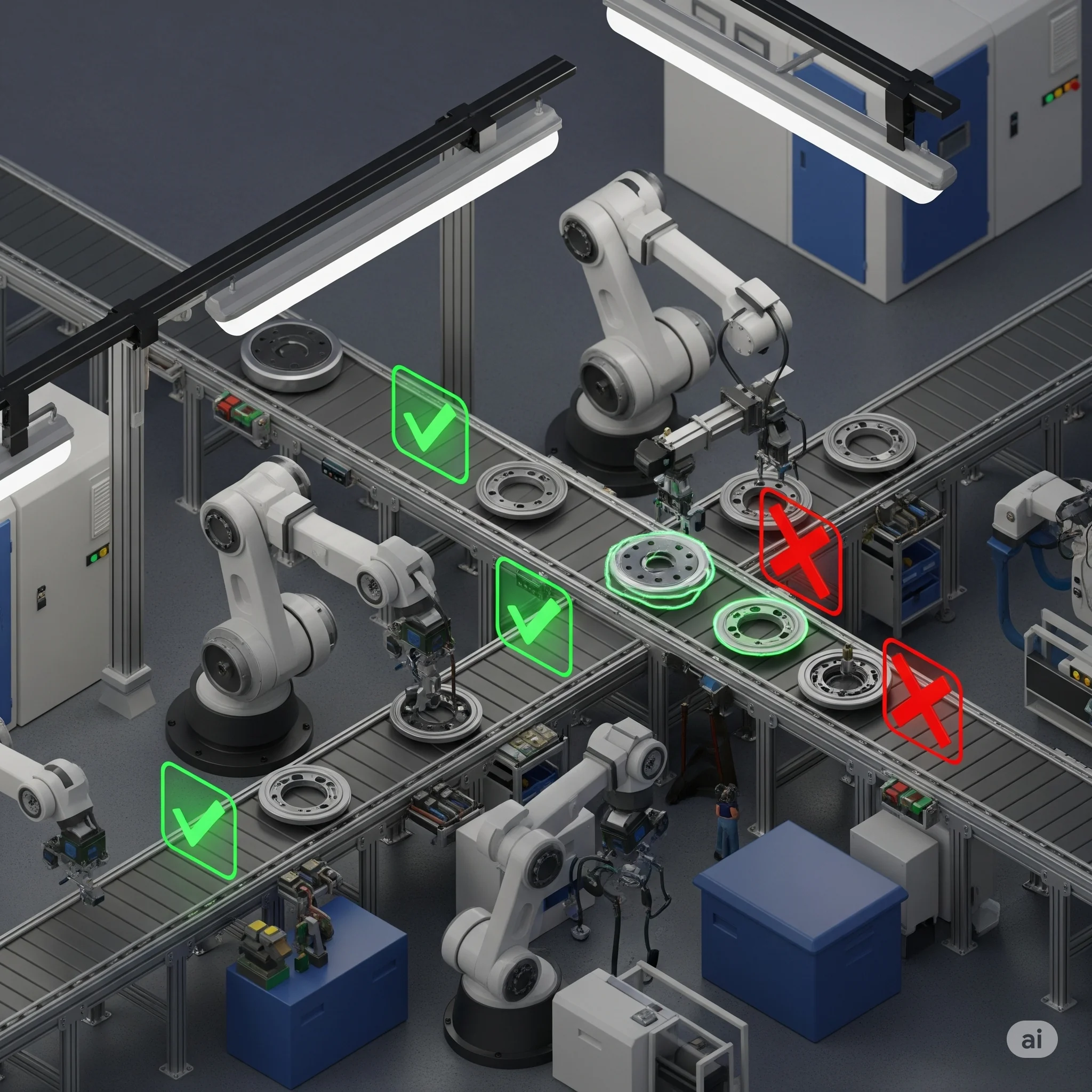
AI-powered Assembly Verification continuously monitors every product during assembly, ensuring each component is present, correctly positioned, and assembled according to predefined specifications before the product advances to the next stage.
Deployment
From Camera Setup to Production Verification
Review the assembly process and verification requirements.
Configure cameras for optimal coverage.
Capture reference images of correct assemblies.
Define assembly rules and required verification checkpoints for each SKU or product variant.
Train AI models for component detection and verification.
Validate detection accuracy across product variations.
Deploy the solution on production lines.
Verify every assembly in real time while triggering alerts, PLC actions, or reject mechanisms when issues are detected.
What The System Verifies
Orama combines AI-powered computer vision with industrial cameras to automatically verify assembly completeness, component placement, fastener installation, wiring, and product configuration in real time. The system ensures every product meets predefined assembly requirements before progressing through production.
Industries We Serve
Orama Assembly Verification helps manufacturers confirm that every product is assembled correctly by verifying component presence, orientation, fasteners, wiring, and assembly completeness in real time.
Verify clips, fasteners, connectors, brackets, wiring harnesses, and assembled components before vehicles move to the next station.
Confirm PCB assemblies, connector placement, cable routing, and component installation with automated verification.
Ensure every component, fastener, and assembly step is completed correctly before final testing.
Verify precision assemblies, component presence, and product configurations to support stringent quality requirements.
Prevent missing components and incorrect product configurations across multiple product variants.
Automate assembly verification for complex mechanical and electromechanical products.
Benefits
Inspect every product with consistent AI-powered verification.
Identify missing, misplaced, or incorrectly assembled components before products leave the line.
Reduce rework by detecting assembly issues immediately.
Automate repetitive verification tasks without slowing production.
Apply SKU-specific verification rules across multiple product variants, ensuring consistent quality even on complex, configurable production lines.
Deploy using existing industrial cameras, PLCs, and automation systems.
Store image-backed verification results and timestamps to support audits, accelerate investigations, and continuously improve assembly processes.
FAQ
Next Step
Every assembly process is unique. Orama's AI-powered Assembly Verification solution can be adapted to your products, assembly workflows, quality requirements, and production environment to ensure consistent verification across every line.
Project Fit