
Upcoming Events: Auto Vision Summit 2026 | Smart Factory Expo 2026 | Live Demos Available

OCR And Barcode Reading

OCR and Barcode Reading for Industrial Traceability

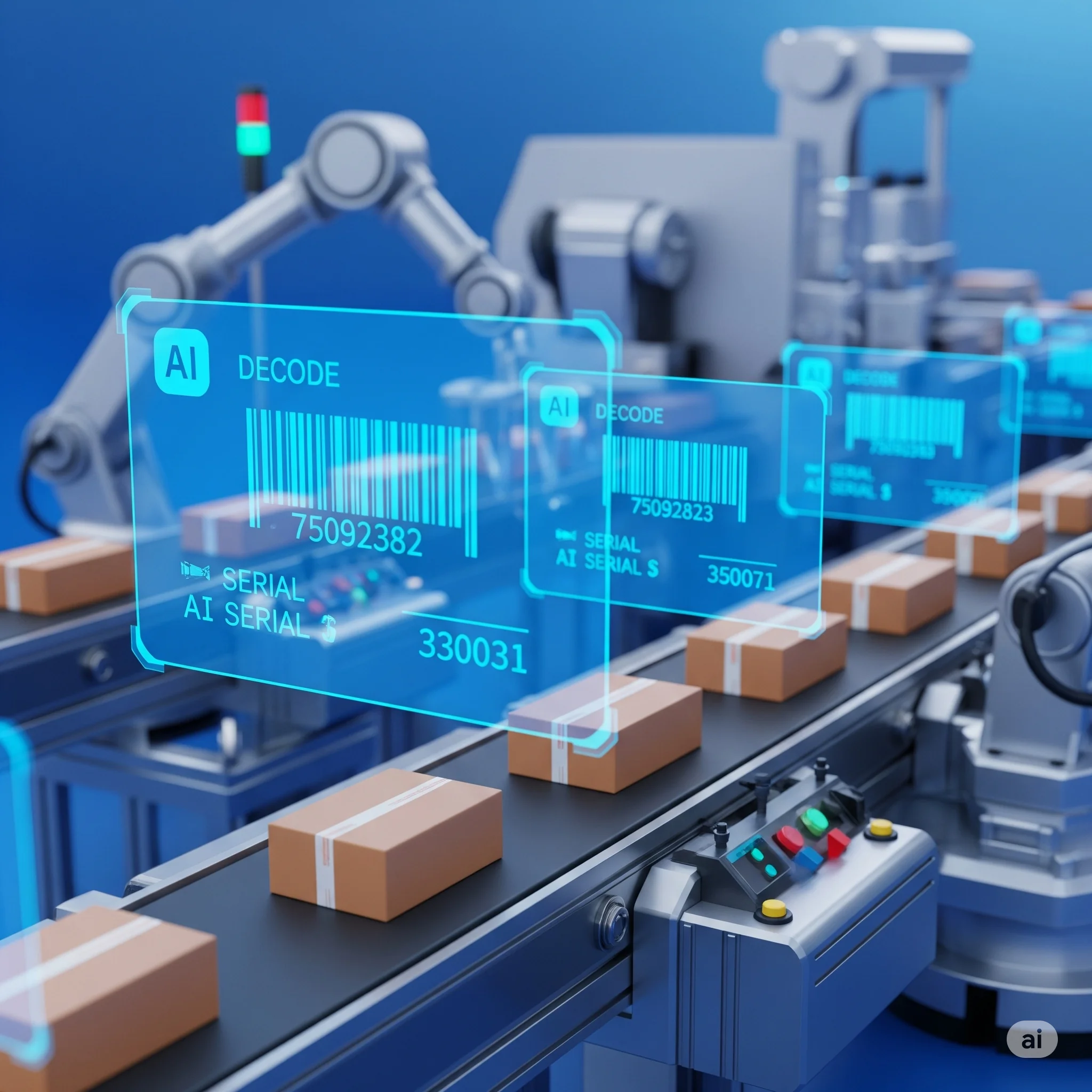
Read text on objects, labels, cartons, and parts while validating barcodes, QR codes, serial numbers, and print quality.

This page is built for users searching for OCR on objects, text reading on products, barcode inspection, or label verification in manufacturing environments where every code, batch number, expiry date, and serial mark must be captured correctly.

Explore No-Code Platform
Industrial OCR and barcode reading application for reading text on objects

Built For Production

Tuned for real line conditions, traceability requirements, and fast operator decisions.

Search Intent

OCR And Barcode Reading

System Compatibility

Built for real manufacturing conditions

Designed for production lines where vision has to fit into existing cameras, PLCs, controllers, and factory automation standards without forcing a complete hardware reset.

System Compatibility

Connect with GenICam-compliant industrial cameras

Built to work with common machine vision camera ecosystems used across inspection and automation deployments.

BaslerBasler
Allied VisionAllied Vision
BaumerBaumer
HikvisionHikvision

99%+

Read success on controlled print conditions

1D/2D

Barcode and QR code support

Live

Validation against expected data rules

Multi-format

Printed text, labels, and direct part marks

Production Challenge

Why teams search for this solution

Manufacturers often search for OCR applications when operators are manually reading part numbers, expiry dates, serial numbers, or barcode labels and errors start affecting compliance, traceability, or dispatch accuracy. The challenge increases when print contrast, orientation, or object curvature changes on the line.

Solution Approach

How Orama deploys the application

Orama deploys OCR and barcode reading pipelines that not only extract text but also validate it against production rules, expected schemas, databases, and print quality conditions. That means the application does more than read characters; it confirms that the right information is printed on the right object.

Typical Project Flow

  • Imaging setup and data capture review
  • Model tuning around line variation
  • Pass or fail logic and deployment

Capabilities

What This Application Does

  • Read printed text, lot numbers, expiry dates, serial numbers, labels, and direct part markings from moving products.
  • Decode 1D barcodes, 2D codes, and QR codes while checking readability and expected code format.
  • Validate extracted text against expected product data, batch logic, SKU rules, or master records.
  • Flag label mismatch, missing print, low-contrast print, or unreadable codes before the product leaves the station.

Deployment Workflow

How Deployment Works

  • Capture images of real labels, objects, and print conditions across production variation.
  • Define the fields to read, the accepted schema, and the fail conditions for each station or SKU.
  • Train and tune OCR or code-reading pipelines for the specific font, mark type, and object geometry.
  • Deploy with pass or fail logic, database checks, and data logging for full traceability.

Use Cases

Common Production Use Cases

  • Reading text on bottles, cartons, pouches, caps, and flexible packaging for batch or expiry validation.
  • Serial number and lot code capture on industrial parts for traceability and warranty records.
  • Barcode and QR code verification on labels, shipping packs, and pharma packaging lines.
  • Label content inspection to catch missing fields, wrong product names, or mismatched printed data.

Business Outcomes

Operational Outcomes

  • Stronger traceability with machine-readable records instead of manual entry.
  • Fewer shipping, compliance, and labeling errors on high-volume lines.
  • Faster operator workflows because data capture happens automatically at the station.
  • More reliable recall readiness through stored text and barcode verification history.

Frequently Asked Questions

Questions buyers usually ask before deployment

Can OCR read text on curved or reflective objects?

Yes, if the imaging setup is designed for that geometry. Curved or reflective surfaces usually need specialized lighting, focus control, and capture angles to keep the text readable for the OCR engine.

What is the difference between OCR and barcode reading?

OCR extracts human-readable text such as serial numbers or expiry dates. Barcode reading decodes machine-readable symbols such as 1D barcodes or QR codes. Many production stations need both in the same workflow.

Can the system verify the text against an ERP or production database?

Yes. The extracted text or decoded code can be checked against expected master data, batch records, SKU rules, or serialization logic so the system can reject mismatches automatically.

Will this help with label inspection too?

Yes. OCR and barcode reading often form the core of a broader label inspection workflow that also checks print presence, content correctness, placement, and readability quality.

Next Step

Need a tailored application page for your exact inspection problem?

We can adapt the same platform for your product geometry, lighting, line speed, traceability rules, and reporting needs without forcing your team into a generic workflow.

View All Applications

Project Fit

  • Single station pilots or full multi-line rollouts
  • Camera, PLC, and edge hardware aligned to your plant setup
  • Traceability, dashboards, and pass or fail logic tailored to the line