No matter how advanced a manufacturing process becomes, product quality ultimately depends on one simple question:
Was the product assembled exactly as intended?
A single missing screw, incorrectly routed cable, misplaced connector, or wrong label can cause product failures, customer complaints, warranty claims, and expensive rework. While many manufacturers rely on manual inspection or sample-based quality checks, increasing production speeds make it harder to verify every product consistently.
That is why assembly verification has become a critical part of modern manufacturing. Whether inspections are performed manually or with AI-powered computer vision, having a structured verification process ensures that important defects are not overlooked.
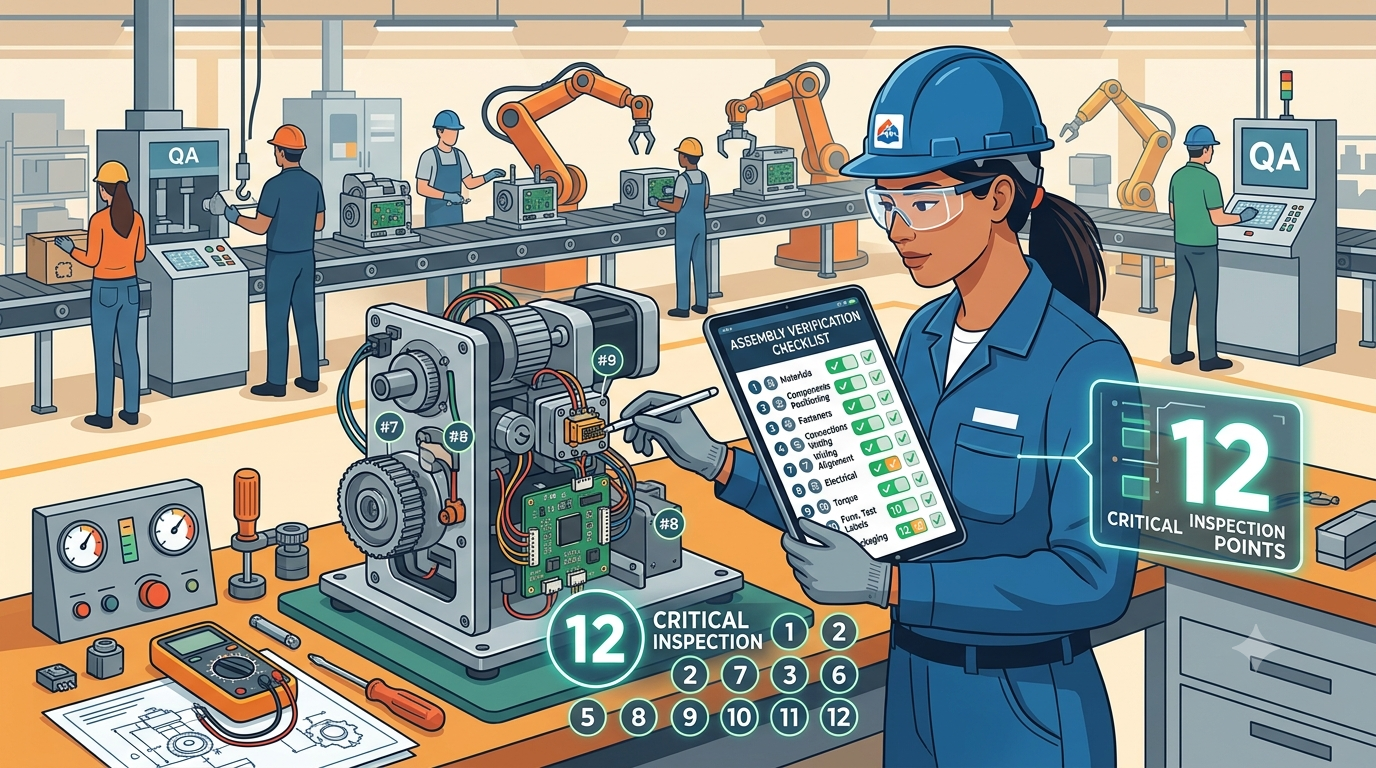
12 Critical Assembly Verification Inspection Points
This checklist highlights twelve of the most important inspection points manufacturers should consider as part of their assembly verification process.
1. Verify Component Presence
The first step is confirming that every required component has been installed.
Missing fasteners, clips, connectors, brackets, seals, or electronic modules are among the most common causes of assembly defects. Even a single missing part can prevent a product from functioning correctly.
AI-powered visual inspection can verify component presence on every product instead of relying on periodic sampling.
2. Confirm Correct Part Orientation
A component may be present but installed incorrectly.
Connectors inserted upside down, reversed brackets, flipped gaskets, or incorrectly positioned sensors can all lead to product failures despite appearing complete during a quick visual inspection.
Computer vision systems compare each product against the correct assembly orientation, helping manufacturers detect these subtle errors in real time.
3. Check Component Positioning
Correct components must also be installed in the correct location.
Even small alignment deviations may affect product performance, safety, or downstream assembly operations.
Automated inspection systems can measure positioning with greater consistency than manual visual inspection, reducing variation across production batches.
4. Verify Fasteners
Loose, missing, or incorrectly installed screws, bolts, clips, and rivets remain one of the leading causes of assembly defects.
Inspection should confirm not only their presence but also whether they are positioned correctly.
Many manufacturers combine torque monitoring with AI-based visual verification to improve confidence in final assembly quality.
5. Inspect Cable Routing
Incorrect cable routing can create reliability and safety issues, particularly in automotive, electronics, and industrial equipment manufacturing.
Inspection should verify that cables follow the correct path, remain securely clipped, and avoid interference with moving components.
AI can identify routing deviations that may be difficult to detect consistently through manual inspection alone.
6. Verify Labels and Identification
Labels, barcodes, QR codes, and serial numbers play an essential role in product traceability.
Inspection should confirm that the correct labels are present, positioned accurately, and remain readable throughout production.
This helps reduce shipping errors while supporting regulatory compliance and after-sales service.
7. Detect Cosmetic Assembly Issues
Not every defect affects functionality immediately, but cosmetic issues still influence customer perception.
Scratches, dents, gaps between assembled parts, damaged housings, or poorly fitted covers should be identified before products leave the factory.
Computer vision enables manufacturers to inspect cosmetic quality without slowing production.
8. Confirm Assembly Completeness
Products often move through multiple assembly stations before reaching final inspection.
Assembly verification should confirm that every required operation has been completed before the product advances.
Incomplete assemblies are much easier to correct immediately than after packaging or shipment.
9. Compare Against Approved Standards
Inspection becomes more reliable when every product is compared against standardized digital references.
AI-powered assembly verification uses trained models based on approved product images, ensuring consistent inspection regardless of production shifts or operator experience.
This reduces subjective decision-making while improving quality consistency.
10. Record Inspection Results
Inspection should not end with a simple pass or fail decision.
Capturing inspection images, timestamps, defect classifications, and production data creates valuable traceability throughout the manufacturing process.
These records support quality audits, customer investigations, and continuous improvement initiatives.
11. Monitor Defect Trends
Individual defects are important, but recurring patterns reveal much more.
Tracking inspection data helps manufacturers identify whether certain assembly errors occur on specific production lines, during particular shifts, or after equipment maintenance.
Instead of reacting to isolated quality issues, manufacturers can eliminate the root causes of recurring defects.
12. Continuously Improve Inspection Processes
Assembly verification should evolve alongside production.
As new product variants are introduced and manufacturing processes improve, inspection systems should adapt accordingly.
AI-powered inspection models can be retrained using new production data, allowing manufacturers to maintain inspection accuracy without redesigning the entire quality process.
Why AI Makes This Checklist Easier to Execute
Following a comprehensive inspection checklist manually becomes increasingly difficult as production volumes grow.
Human inspectors must make hundreds of rapid decisions every hour, increasing the likelihood of fatigue and inconsistent evaluations.
AI-powered assembly verification simplifies this process by automatically applying the same inspection criteria to every product.
Instead of replacing quality teams, AI supports them by performing repetitive visual inspections while providing immediate feedback, complete traceability, and production analytics.
This enables inspectors and engineers to focus on process improvements rather than repetitive checking.
Building a Smarter Assembly Verification Process
A checklist is only effective if it can be executed consistently.
Modern manufacturers are moving beyond sample inspections toward verifying every product in real time. By combining structured inspection processes with AI-powered computer vision, organizations can reduce defects, improve traceability, and maintain quality even as production volumes increase.
At Orama Solutions, our Assembly Verification platform automates these inspection steps using Vision AI, helping manufacturers verify components, detect assembly errors instantly, and maintain consistent quality across high-speed production environments.
Whether you manufacture automotive components, electronics, medical devices, consumer goods, or industrial equipment, a structured assembly verification process supported by AI helps ensure that every product reaching your customer meets the expected quality standard.
Know more about industries we serve
Turn your inspection checklist into an automated quality process. Explore Orama's Assembly Verification solution to see how Vision AI verifies every product in real time, reduces manual inspection effort, and helps maintain consistent manufacturing quality.
Click here to Book Demo or request FREE audit for your system