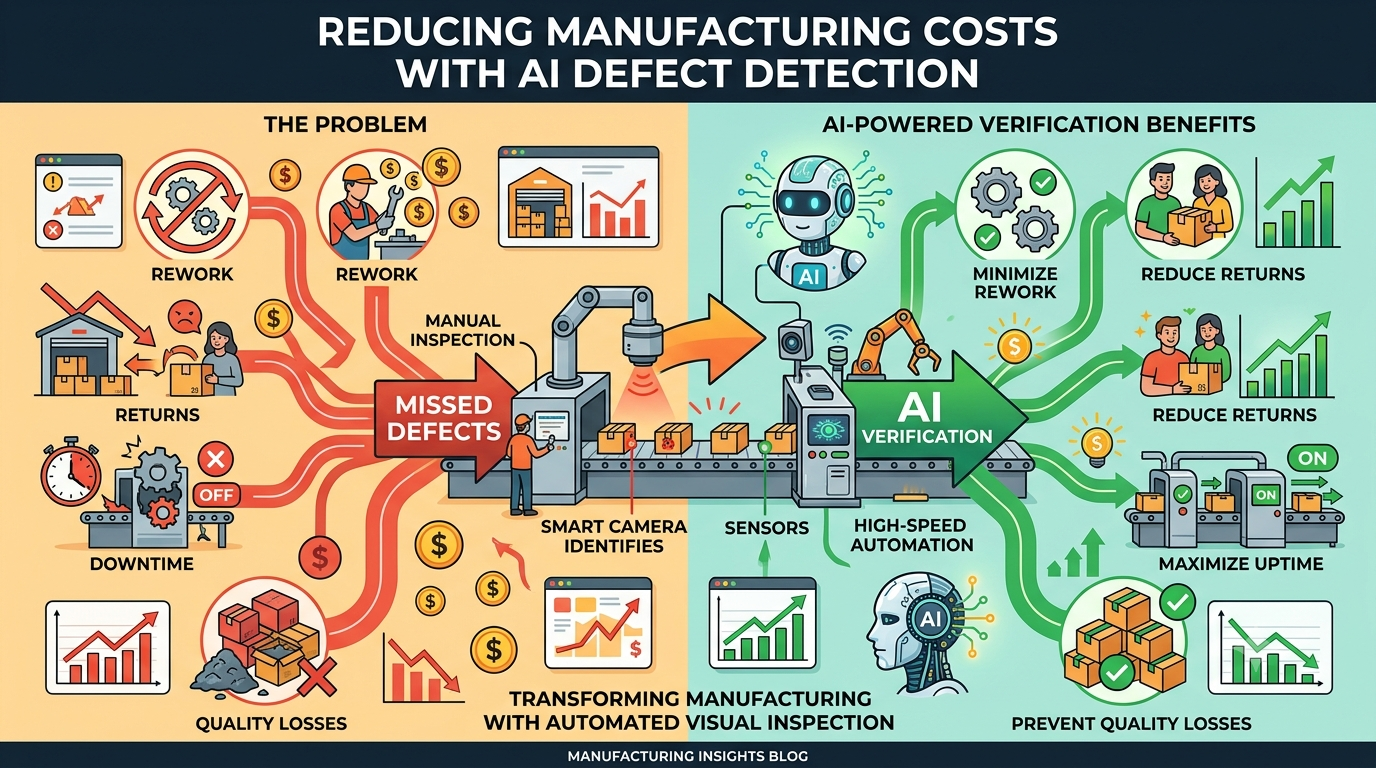
Every manufacturer understands that quality matters. What often goes unnoticed, however, is how expensive poor quality can become when assembly defects slip through the production line. A missing fastener, an incorrectly placed connector, or a misaligned component may seem like a minor issue during assembly, but once the product reaches a customer, that small mistake can lead to warranty claims, product recalls, production delays, and damaged customer relationships.
For many manufacturers, the conversation around AI-powered assembly verification begins with technology. But it quickly shifts to something much more practical: return on investment (ROI).
Can AI inspection actually save enough money to justify the investment?
The answer lies in understanding the true cost of missed defects and how AI helps prevent them.
The True Cost of an Assembly Defect
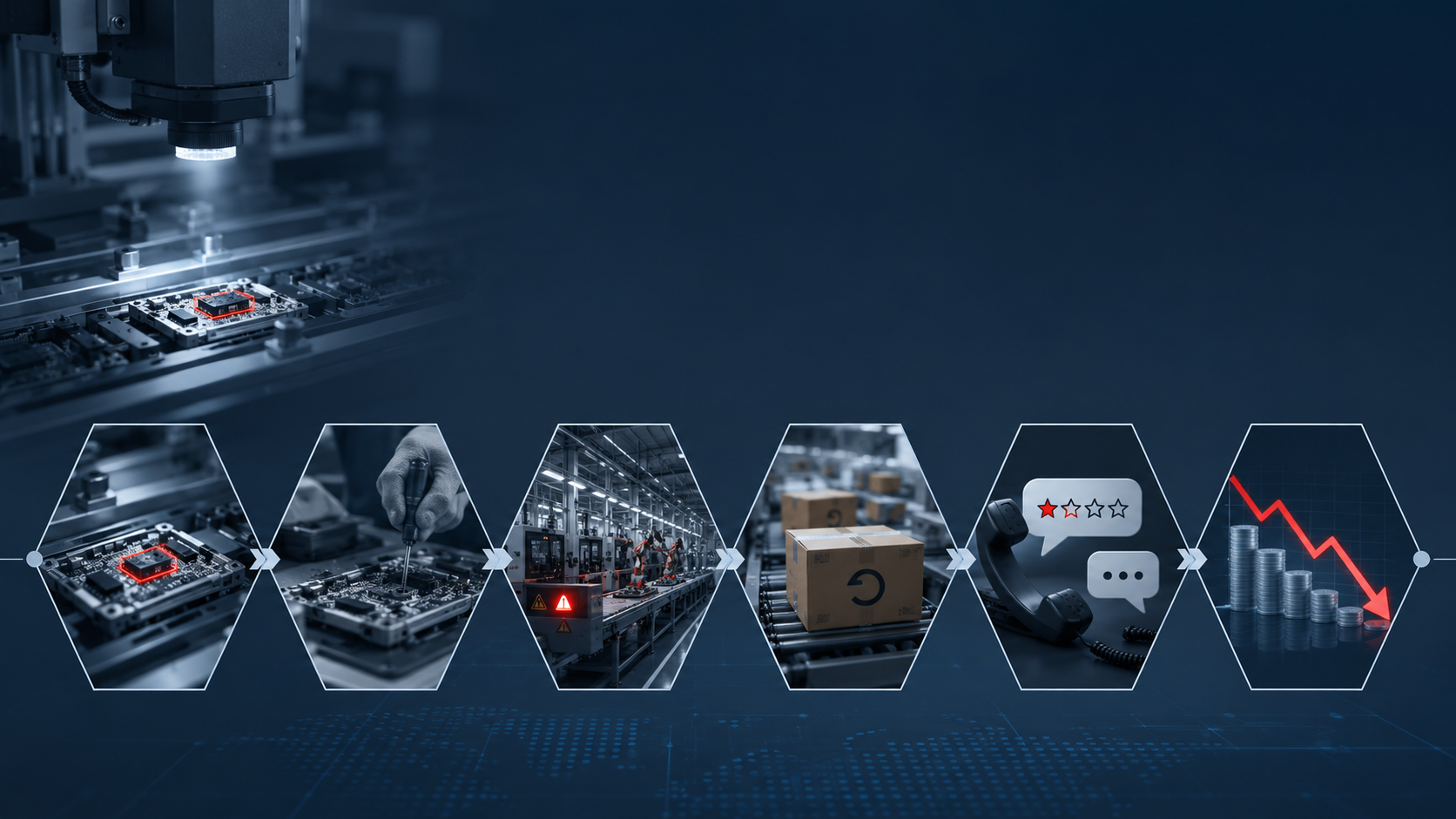
When manufacturers calculate the cost of a defect, they often focus on the immediate expense of repairing or replacing a faulty product. In reality, the total cost is much higher.
A defect discovered immediately after assembly may require only a few minutes of rework. The same defect discovered during final testing could delay production schedules and consume valuable engineering time. If the defect reaches a customer, the costs multiply further through warranty replacements, reverse logistics, customer support, and potential damage to brand reputation.
The later a defect is detected, the more expensive it becomes to resolve.
This is why manufacturers are investing in inspection systems that identify problems at the earliest possible stage.
Where Manual Inspection Falls Short
Manual inspection has long been an important part of quality assurance, but maintaining consistent accuracy becomes increasingly difficult as production volumes grow.
Inspectors may experience fatigue after reviewing thousands of products during a shift. Different operators may apply inspection criteria differently, leading to inconsistent quality. As production speeds increase, inspectors have less time to evaluate each product thoroughly.
These challenges don't necessarily mean manual inspection is ineffective, it simply wasn't designed for today's high-speed, high-volume manufacturing environments.
Missed defects are an inevitable consequence of repetitive inspection tasks performed under production pressure.
How AI Improves the Economics of Quality
AI-powered assembly verification changes the economics of inspection by identifying defects as products move through the production line.
Using computer vision, the system automatically checks every assembled product for missing components, incorrect orientation, misplaced parts, incomplete assemblies, and other visual defects.
Because inspections happen in real time, defective products can be removed or corrected before additional manufacturing steps are completed.
This early detection significantly reduces the cost of rework while preventing defective products from reaching customers.
Instead of relying on sample-based inspection, manufacturers gain confidence that every product has been verified.
Areas Where Manufacturers See ROI
One of the biggest financial benefits comes from reducing rework. Detecting assembly errors immediately means products can often be corrected within the same production cycle, avoiding unnecessary labor and production delays.
Scrap reduction is another important advantage. Identifying issues before downstream processes prevents additional material, labor, and energy from being invested in defective products.
Warranty claims also decrease when fewer assembly defects escape the factory. Lower warranty costs not only improve profitability but also strengthen customer confidence in product quality.
Manufacturers also benefit from improved productivity. Instead of assigning inspectors to repetitive visual checks, skilled employees can focus on process optimization, root cause analysis, and continuous improvement initiatives.
Finally, AI inspection creates detailed inspection records that simplify audits, improve traceability, and support regulatory compliance.
Looking Beyond Direct Cost Savings
The value of AI assembly verification extends beyond measurable financial savings.
Manufacturers gain greater confidence in product quality because every unit is inspected consistently. Production teams receive immediate feedback when defects occur, allowing them to identify process issues before they become recurring problems.
Engineering teams can analyze inspection data to understand defect trends, compare production performance across shifts, and identify opportunities for continuous improvement.
This operational visibility helps organizations improve manufacturing efficiency over time rather than simply reacting to quality failures.
Calculating ROI for Your Production Line
Every manufacturing environment is different, so ROI depends on factors such as production volume, defect rates, labor costs, warranty expenses, and inspection complexity.
Questions worth considering include:
How many products are inspected each day?
How many assembly defects require rework?
What is the average cost of reworking one product?
How many customer complaints are linked to assembly errors?
How much production time is lost investigating quality issues?
How much manual inspection effort is required each shift?
Even small improvements in defect detection can generate significant annual savings when multiplied across thousands or millions of products.
Rather than viewing AI inspection as an additional expense, many manufacturers recognize it as an investment that reduces the ongoing cost of poor quality.
Choosing an AI Inspection Partner
Achieving a strong return on investment requires more than purchasing cameras and software.
Manufacturers should look for solutions that integrate with existing production lines, adapt to multiple product variants, generate actionable inspection analytics, and scale alongside future production requirements.
Equally important is working with a technology partner that understands industrial manufacturing processes and can tailor inspection models to specific assembly challenges.
At Orama Solutions, our Assembly Verification platform combines Vision AI and computer vision to inspect every product in real time, helping manufacturers reduce defects, improve traceability, and lower the overall cost of quality.
Click here to request free system audit
Investing in Long-Term Quality
Quality has always been a competitive advantage in manufacturing. Today, it is also a data challenge.
Manufacturers that rely solely on manual inspection often struggle to maintain consistent quality as production grows. AI-powered assembly verification provides the speed, consistency, and insights needed to inspect every product while reducing the hidden costs associated with missed defects.
The question is no longer whether manufacturers can afford to adopt AI inspection. Increasingly, the question is whether they can afford not to.
For organizations looking to improve quality, reduce operational costs, and build more resilient manufacturing processes, AI-powered assembly verification offers measurable value that extends far beyond defect detection.
Want to quantify the ROI for your production line? Explore Orama's Assembly Verification solution to see how AI-powered inspection can reduce rework, minimize warranty claims, improve traceability, and deliver long-term savings through smarter quality control.