For decades, manual inspection has been the backbone of quality control in manufacturing. Skilled inspectors have ensured products leave the production line with the right components, proper assembly, and minimal defects. But as production volumes increase and products become more complex, manufacturers are beginning to ask an important question:
Can manual inspection still keep up?
The answer depends on what your production line demands. For low-volume operations with simple assemblies, manual inspection may still be sufficient. However, manufacturers producing thousands of products every shift often discover that maintaining consistent inspection quality becomes increasingly difficult.
This is where AI-powered assembly inspection is making a significant impact. Rather than replacing human expertise, AI provides manufacturers with a faster, more consistent, and highly scalable approach to assembly verification.
Manual Inspection: Strengths and Limitations
Human inspectors bring experience, judgment, and flexibility that machines cannot always replicate. They can adapt to unusual situations, identify unexpected issues, and make decisions based on context.
However, manual inspection also comes with natural limitations.
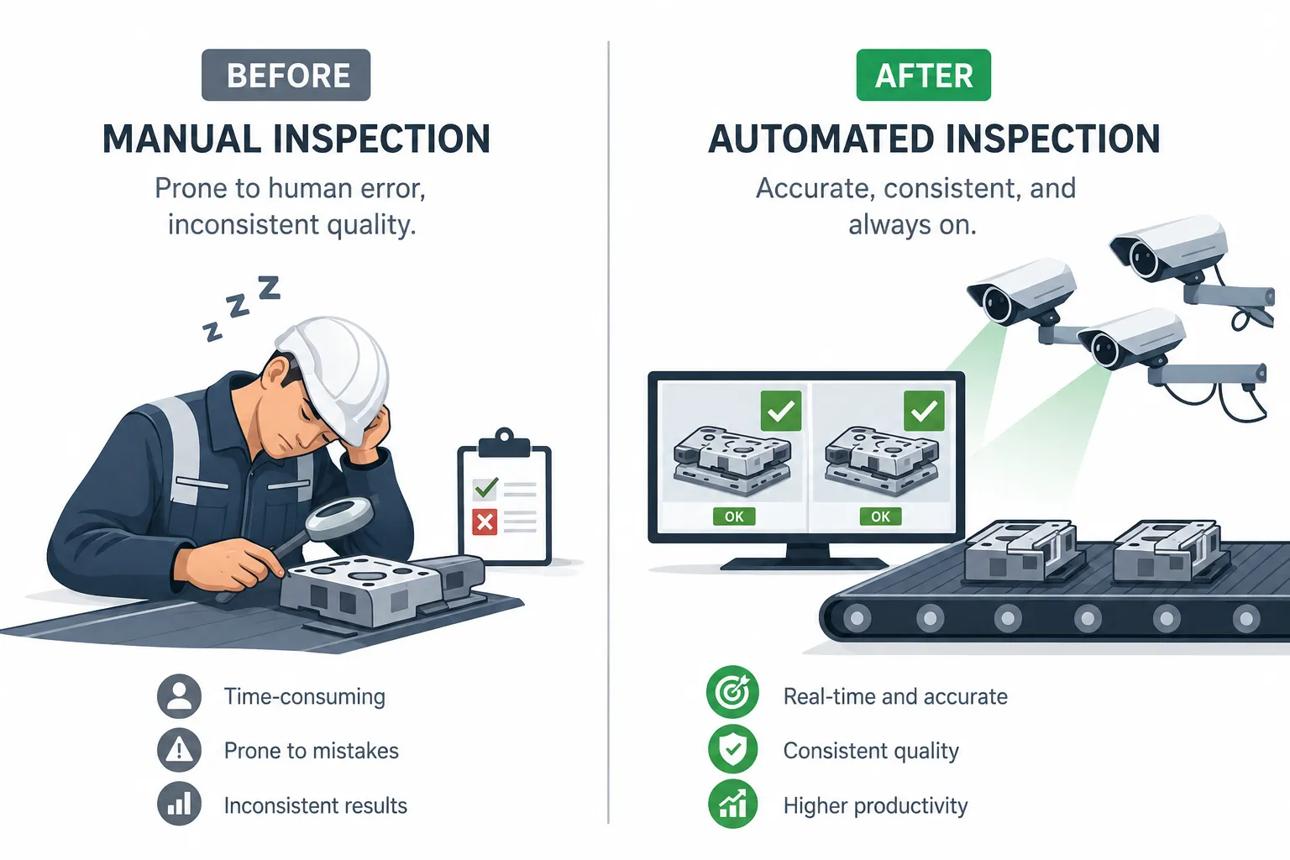
Visual fatigue is one of the biggest challenges. Inspecting hundreds or thousands of nearly identical products during a shift reduces concentration over time, making it easier for small defects to be overlooked.
Consistency is another concern. Two inspectors may evaluate the same product differently, particularly when defect criteria are subjective.
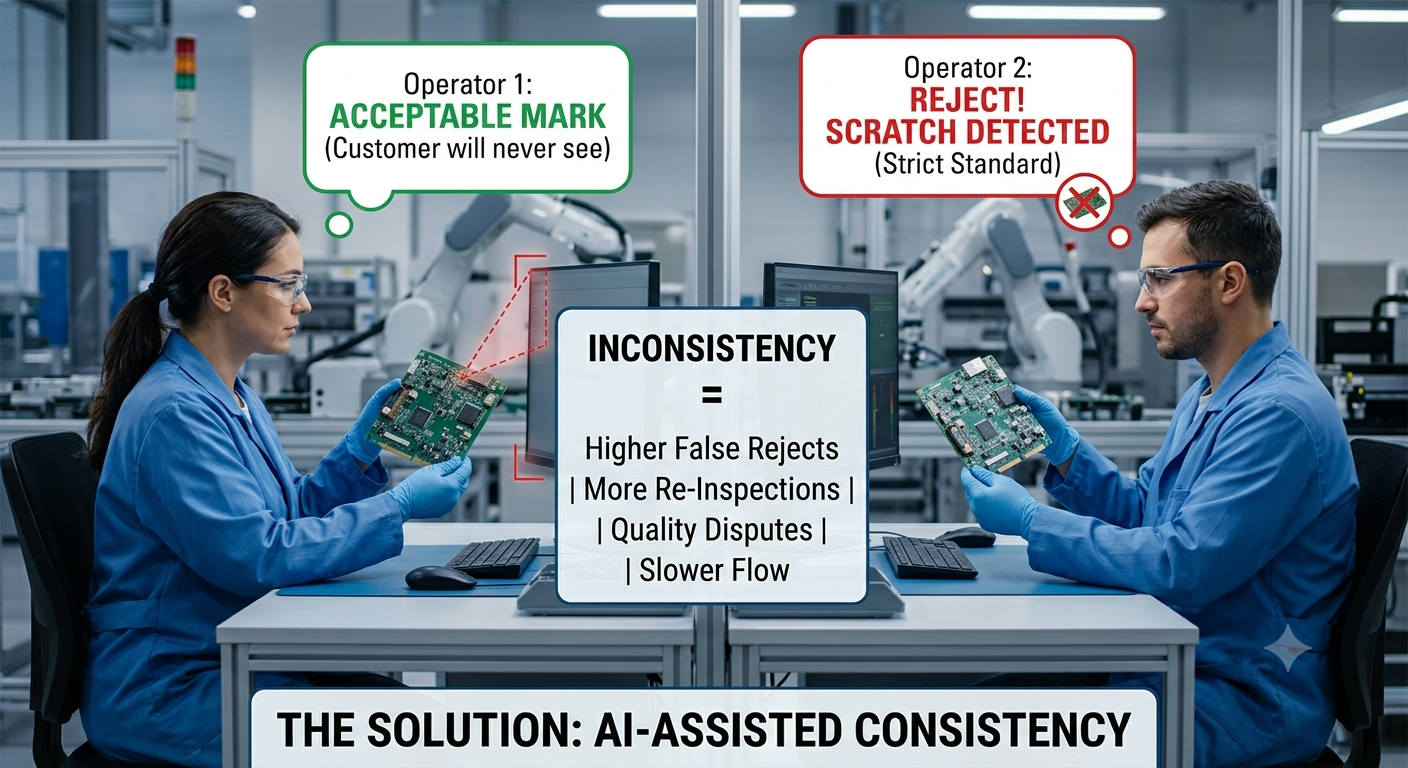
Inspection quality can also vary across shifts, factories, or production teams.
As production speeds increase, inspectors have less time to examine each product thoroughly. This creates a difficult trade-off between inspection speed and inspection accuracy.
These challenges aren't caused by lack of skill-they are simply the reality of repetitive visual inspection in high-volume manufacturing.
How AI Assembly Inspection Works
AI assembly inspection uses industrial cameras and computer vision models trained to recognize both correctly assembled products and common defects.
Instead of checking only a few samples, AI inspects every product moving through the production line.
It can verify:
Component presence
Correct orientation
Proper positioning
Missing screws or fasteners
Incorrect labels
Cable routing
Assembly completeness
Every inspection follows the same criteria, regardless of shift timing, production volume, or operator availability.
The result is a highly standardized inspection process capable of operating continuously without fatigue.
Comparing AI and Manual Inspection
When manufacturers compare inspection methods, accuracy is only one part of the decision. Several other factors influence overall quality performance.
Consistency
Manual inspection quality naturally varies between inspectors and shifts. AI applies identical inspection rules to every product, creating consistent quality standards throughout production.
Speed
A human inspector can evaluate products quickly, but production lines often move faster than manual inspection can reliably support. AI performs inspections in milliseconds while keeping pace with automated manufacturing lines.
Scalability
Hiring and training additional inspectors becomes necessary as production grows. AI inspection systems scale with production volumes, allowing manufacturers to inspect more products without proportionally increasing inspection resources.
Traceability
Manual inspections typically rely on checklists or operator records. AI inspection automatically stores images, inspection results, timestamps, and defect information, creating complete digital traceability for every inspected product.
Continuous Improvement
AI systems generate valuable production data that helps manufacturers identify recurring defects, process variations, and quality trends. Manual inspection rarely provides this level of analytical insight.
Is AI Always More Accurate?
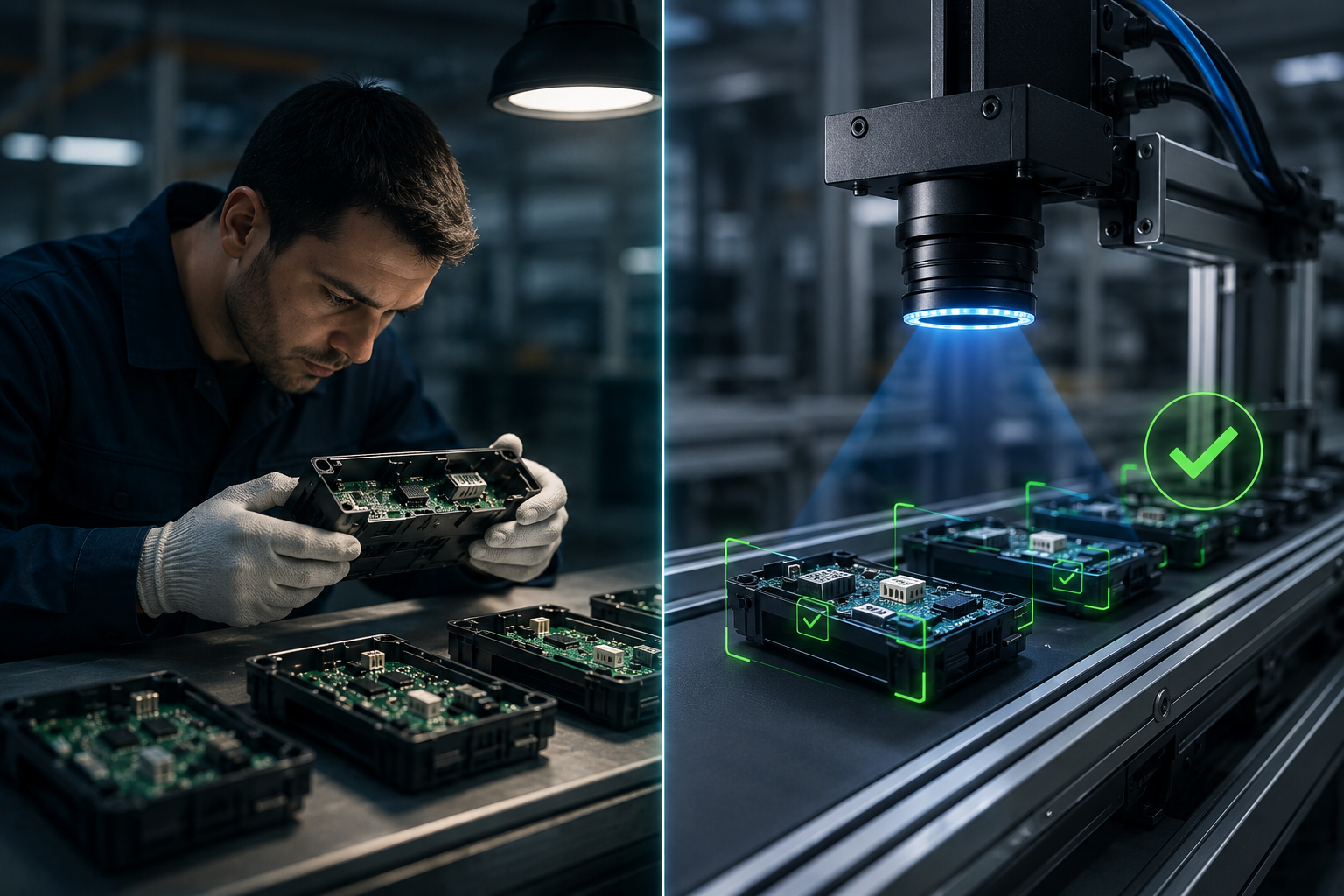
Accuracy depends on several factors, including lighting conditions, camera placement, inspection objectives, and model training.
A well-trained AI system can consistently detect specific assembly defects with a level of repeatability that is difficult for humans to maintain over long production runs.
However, AI performs best when implemented as part of a well-designed inspection process. Proper camera positioning, high-quality training images, and ongoing model optimization are essential for achieving reliable results.
In practice, many manufacturers achieve the best outcomes by combining human expertise with AI automation.
AI performs repetitive, high-speed visual inspection, while operators focus on process improvements, exception handling, and quality investigations.
This partnership allows manufacturers to improve inspection performance without losing valuable human knowledge.
When Should Manufacturers Consider AI Inspection?
Manufacturers typically begin evaluating AI assembly inspection when they experience recurring quality issues or production bottlenecks.
Common indicators include:
Increasing production volumes
Frequent customer complaints
High rework costs
Missed assembly defects
Multiple product variants
Difficulty maintaining inspection consistency across shifts
If these challenges sound familiar, AI inspection may provide a strong return on investment by improving both quality and operational efficiency.
The Future of Assembly Verification
Manufacturing quality is no longer measured by random sampling or periodic inspections. Today's factories are moving toward inspecting every product in real time.
AI-powered assembly verification makes this possible by combining speed, consistency, and data-driven decision-making.
At Orama Solutions, our Assembly Verification platform helps manufacturers automate visual inspection, detect assembly defects instantly, and improve production quality without slowing down the assembly line.
As manufacturing continues to embrace Industry 4.0, the question is no longer whether AI can support assembly inspection.
The real question is how quickly manufacturers can adopt it to stay competitive.
If you're evaluating ways to improve inspection accuracy while reducing quality costs, AI-powered assembly verification is a practical next step toward smarter manufacturing.
Keep Your Assembly Verification System Performing at Its Best
Deploying an AI-powered assembly verification system is only the first step. As products evolve, production conditions change, and new variants are introduced, inspection systems also need regular monitoring and optimization to maintain high accuracy and consistency.
At Orama Solutions, we partner with manufacturers beyond deployment to ensure their inspection systems continue delivering reliable results over time. Through our subscription-based support model, we help quality and production teams continuously improve inspection performance by:
*Conducting regular health checks of AI inspection systems
*Monitoring inspection accuracy and consistency across production lines
*Fine-tuning AI models as products and processes evolve
*Identifying emerging defect trends before they become recurring quality issues
*Reducing false rejects and minimizing unnecessary re-inspection
This continuous improvement approach helps manufacturers maintain reliable assembly verification, reduce quality-related disruptions, and maximize the long-term value of their AI investment.
If you're looking to move beyond manual inspection and build a scalable, reliable assembly verification process, Orama Solutions can help you deploy, optimize, and continuously improve AI-powered inspection across your manufacturing operations.
Talk to our experts to discover how Vision AI and Assembly Verification can help improve quality, reduce rework, and keep your production running with confidence.
Talk to an expert on +91 99992 82700