Every plant has the same quality headaches: defects that reach the customer, rework that eats into margins, scrap that nobody can trace back to a cause, and inspectors who cannot keep up when the line speeds up.
Machine vision applications in manufacturing are built to fix exactly these problems. Cameras, lighting, and software check every product as it moves through the line and flag problems the moment they happen, not hours later at final inspection.
In our guide to machine vision for manufacturing, we explained how the technology works. This article is more practical. It shows where plants actually use it, which problem each use case solves, and where to start.
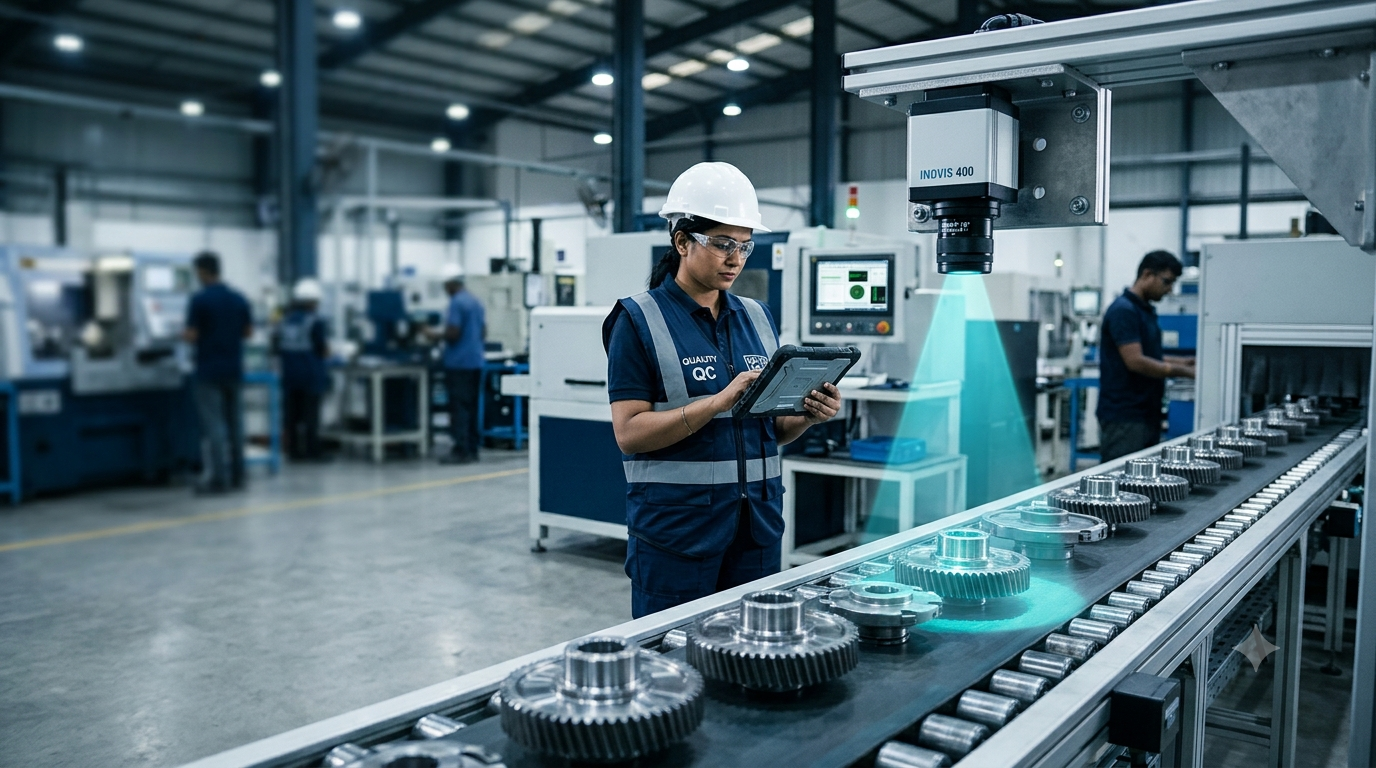
Why Manual Inspection Falls Short on Busy Lines
Manual inspection works well until volumes, line speeds, or tolerances grow. Then the same problems start to appear:
Inspectors get tired over a shift, and small defects get missed.
Two inspectors can judge the same part differently.
Only a sample is checked, so a bad batch can slip through.
Problems are found late, after more bad parts have been made.
There is little record to show a customer or auditor what was actually checked.
Machine vision does not remove the need for skilled people. It takes over the repetitive checking so your team can spend its time on exceptions, root causes, and process fixes.
What Is Machine Vision Used for in Manufacturing?
A machine vision system looks at a product and answers simple yes or no questions:
Is it assembled correctly?
Is it free from visible defects?
Is it within size tolerance?
Is it labelled and packed correctly?
Can its code be read?
The result goes straight to the line, so a bad part can be rejected automatically, an operator can be alerted, or the machine can be stopped. It is inspection that happens on the line, on every piece, instead of on a sample.
10 Machine Vision Applications in Manufacturing
1. Automated Defect Detection
The problem: Defects are found late, at final inspection or, worse, by the customer.
What vision does: It checks every product as it passes through the line and flags visible problems such as:
Scratches, cracks, and dents
Discoloration and contamination
Missing features
Damaged components
This kind of automated visual inspection catches issues at the stage where they are cheapest to fix, and a good vision inspection system also records what it finds. For defect types across automotive, pharma, and consumer goods, read our guide to defect detection across industries, or check our defect detection application. Defects that vary a lot in size and shape are a good fit for AI-based inspection, which we compare with standard vision in AI Vision vs Machine Vision.
Example: A plant making machined metal parts checks every part for scratches and dents on the line, so a damaged batch is caught within minutes instead of at the end-of-shift audit.
2. Assembly Verification
The problem: One missing, wrong, or incorrectly placed component can cause a product failure or a costly rework loop.
What vision does: It checks that every required component is present, correct, in the right position, and in the right orientation, before the product moves to the next station.
This is most valuable where manual checks are repetitive and where mistakes are hard to spot once the product is closed up. For more detail, read What Is Assembly Verification in Manufacturing? and 10 common assembly defects AI can detect, or see our assembly verification application.
Example: A plant assembling electrical enclosures confirms that every terminal, screw, and cover is fitted before the unit is closed and sent for testing.
3. Dimensional and Measurement Inspection
The problem: Parts drift out of tolerance and manual gauging cannot keep up with volume.
What vision does: It measures features such as length, width, diameter, gaps, angles, and alignment from an image and marks each part as pass or fail against your tolerance limits.
For very high-precision metrology work, a dedicated vision measuring machine (VMM) is often used in the quality lab. In-line machine vision complements it by checking every part on the line instead of a sample.
Example: A maker of stamped components checks hole position and gap width on every piece, so drift is spotted before parts go out of tolerance.
4. Presence and Absence Detection
The problem: A missing screw, connector, seal, or label slips through because the check is simple and repetitive.
What vision does: It confirms that a part or feature is there, in the expected place, every time.
This is one of the simplest and most affordable applications, and it often pays back quickly when the same check has to be done thousands of times a day.
Example: On a packing line, a camera confirms that the leaflet, cap, and seal are all present before each carton is closed.
5. OCR and Barcode Inspection
The problem: Wrong labels, unreadable codes, and weak traceability lead to mix-ups, customer complaints, and audit findings.
What vision does: It reads and verifies:
Barcodes and QR codes
Serial and lot numbers
Printed text and labels
It can also confirm that the right code is on the right product. This supports batch tracking, serialization, and clean quality records. See our OCR and barcode reading application.
Example: A pharma or FMCG line checks that the batch number and expiry date are printed clearly and match the label before dispatch.
6. Surface Inspection
The problem: Scratches, dents, stains, and finish defects hurt appearance and performance, and they are easy to miss by eye at line speed.
What vision does: It inspects surfaces under controlled lighting. Typical products include metal and plastic parts, electronic components, automotive parts, battery components, and finished consumer goods.
Lighting matters as much as the camera here. The right lighting makes a defect visible, and the wrong lighting hides it. Many failed deployments trace back to setup rather than the camera, as we explain in Why Machine Vision Systems Fail.
Example: A plastic moulding unit inspects visible surfaces for flow marks and scratches under controlled lighting before parts reach the customer.
7. Packaging Inspection
The problem: Packaging errors cause rejected consignments, customer complaints, regulatory issues, and waste.
What vision does: It checks label presence and position, printed information, barcode readability, seal condition, and pack completeness before products leave the plant.
Example: A food manufacturer checks that every pack has a label, a clear date code, and a sealed lid before it goes into the carton.
8. Part Identification and Classification
The problem: Similar-looking parts or variants get mixed up and enter the wrong process.
What vision does: It identifies parts by shape, size, colour, markings, or geometry, so the right component goes to the right place.
Example: A plant running several part variants confirms that the right variant is on the right line, so it does not end up in the wrong product.
9. Robotic Guidance and Positioning
The problem: Robots need parts to arrive in exactly the same position every time, which makes lines rigid and fixturing expensive.
What vision does: A robot vision system tells the robot where a part is, how it is oriented, and which one to pick. This is also called vision-guided robotics.
It allows robots to handle parts that are not perfectly placed, which makes picking, sorting, assembly, and material handling more flexible.
Example: A robot picks loosely placed parts from a tray because the camera tells it where each one is, so the line does not need costly fixtures to hold every part in place.
10. Quality Control and Process Monitoring
The problem: Defects keep recurring, but no one can say where or why they start.
What vision does: Instead of checking only the finished product, vision can inspect at several points: incoming material, assembly, final inspection, and packing.
When results are recorded consistently, teams can see patterns such as rising defect rates, repeat assembly errors, or issues linked to a particular machine or shift. That turns inspection from a final gate into a tool for fixing the process.
Example: A plant notices that defects rise on one shift or after a tool change, and uses the inspection records to trace the cause instead of guessing.
Who Benefits Most in Your Plant from Machine Vision Application
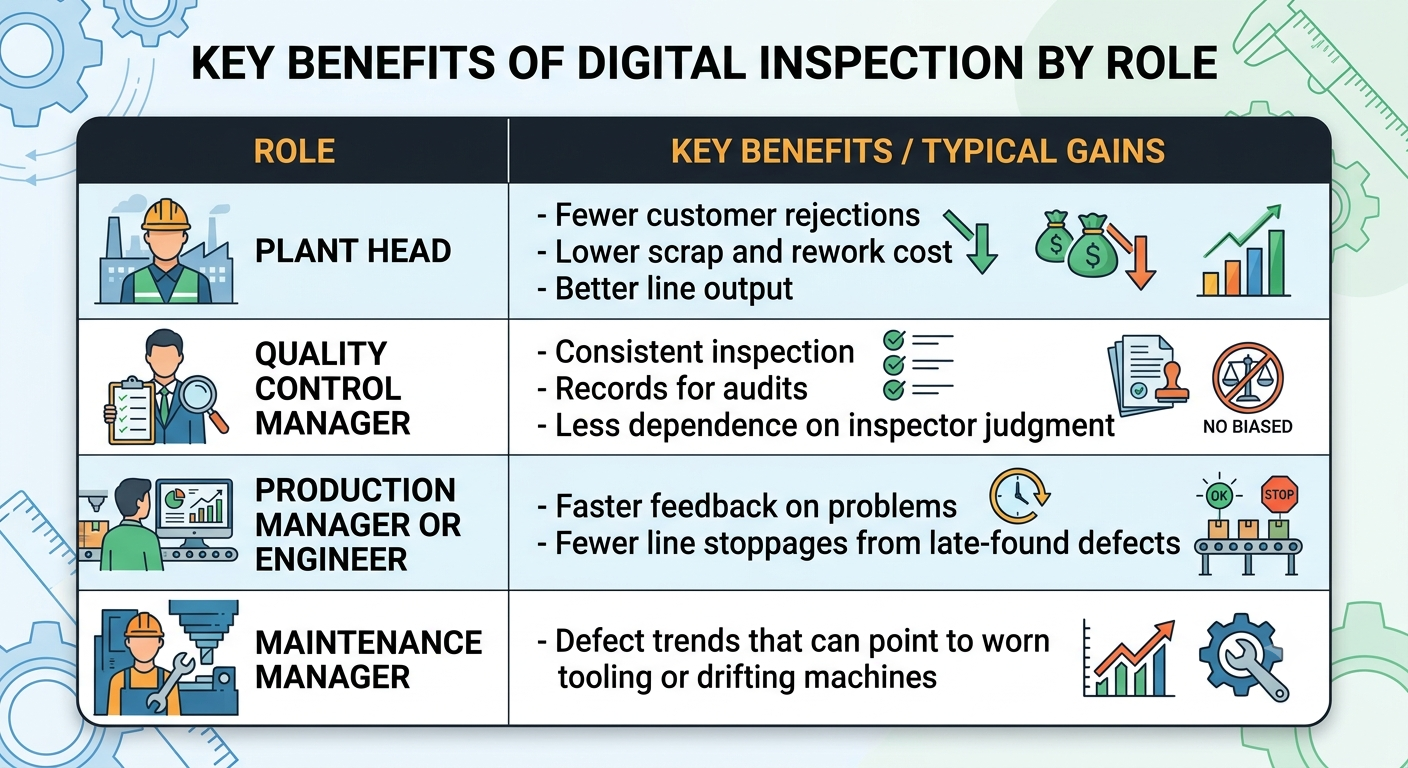
Benefits at a Glance of Machine Vision Applications
The value depends on the application, but the benefits are consistent across plants:
Consistent inspection: the same criteria applied to every part, every shift.
Speed: checks at line speed, on every product.
Earlier detection: problems caught before they travel down the line.
Less scrap and rework: process issues fixed before large batches go wrong.
Better traceability: inspection results linked to products and batches.
Better use of people: inspectors move from repetitive checking to judgment and problem-solving.
For a deeper look at costs and ROI, read The True Cost of Poor Inspection vs the ROI of Reliable Visual Inspection and the benefits and ROI sections of our machine vision for manufacturing guide. Inconsistent manual checks also carry hidden costs.
Do You Need AI for Every Application?
No. Many checks are simple and rule-based, such as confirming a part is present or measuring a clearly defined dimension. Standard machine vision handles these well, and often at a lower cost.
AI-based inspection becomes useful when defects look different each time, when products have natural variation, or when the rules are hard to write down. The right choice depends on your product and your defects, not on what sounds most advanced. Our guide to AI Vision vs Machine Vision compares the two approaches in more detail.
Where Machine Vision Is Used in Indian Manufacturing
Indian plants face rising customer expectations, export audits, and tight margins. These are the sectors where we see the clearest use cases:
Automotive and auto components
surface and dimensional checks on machined parts, assembly verification, and part identification for OEM and export customers. See our automotive solutions.
Electronics and EMS
component presence, marking checks, and defect detection on dense assemblies. See PCBs and electronics.
Battery and EV components
inspection and verification across cell, module, and pack assembly. See Battery and EV.
Pharmaceuticals
label, packaging, and print verification to support compliance and traceability. See Pharma and Medical.
Food and FMCG
label verification, seal and pack checks, and product classification at high line speeds. See Food and Beverage and Consumer Goods.
The exact setup differs by industry and product, so start from the problem you want to solve rather than from the technology.
How to Pick Your First Application
Most plants do best by starting small with one high-impact check. Ask these questions first:
What is costing you the most today? Customer rejections, rework hours, scrap, or audit findings. Start where the cost is highest.
What exactly must be checked? A part, an assembly, a surface, a label, or a package.
How fast is the line? The system must keep pace with your cycle time.
How much does the product vary? More variation points toward a more flexible inspection approach.
What accuracy do you need? Decide how many missed defects and false rejects you can accept.
What must it connect to? PLCs, robots, rejection mechanisms, or your MES and quality records.
Evaluate these together. Choosing a camera first often leads to the wrong system. Before you buy, read Top 10 Mistakes That Cause Vision Systems to Fail in Manufacturing.
What a First Machine Vision Project Usually Looks Like
Most successful projects follow a simple path:
Define the problem. One defect, one station, and one clear pass or fail rule.
Collect samples. Good parts, bad parts, and borderline cases from your own line.
Run a pilot. Test on real parts before you commit to a full rollout.
Connect it to the line. Link it to your reject mechanism, PLC, and quality records.
Tune and hand over. Adjust on live production, and train operators and maintenance staff to run it.
Keep the first project small. A single station gives you real results from your own plant, and those results make it much easier to decide where to go next.
Frequently Asked Questions on Machine Vision Applications
Is machine vision only for large factories?
No. Many applications, such as presence checks or code reading, are simple enough for small and mid-sized plants. Starting with one station keeps cost and risk low.
Will machine vision replace our inspectors?
Usually not. It takes over repetitive checks, while people handle judgment calls, exceptions, and process improvement.
Can it work with our existing production line?
In most cases, yes. Systems are designed to connect to PLCs, rejection mechanisms, and quality records. Line speed, layout, and available space all matter, so confirm the fit at the pilot stage.
How accurate is machine vision inspection?
It depends on the application, the lighting, and the quality of the setup. Agree on acceptable levels of missed defects and false rejects up front, and test against them on your own parts.
Where should we start with machine vision application?
With the problem that costs you the most today. The section on picking your first application above walks through the questions to ask.
Machine vision is not one product. It is a set of practical tools for specific shop-floor problems: catching defects early, verifying assemblies, measuring parts, reading codes, checking packaging, guiding robots, and finding where problems start.
The plants that get the most from it do not begin with the technology. They begin with one clear question: which quality problem is costing us the most right now?
To go further:
Start with the pillar guide, Machine Vision for Manufacturing: Applications, Benefits, Components & How It Works, for how it works, components, benefits, and ROI.
Compare approaches in AI Vision vs Machine Vision.
Avoid common pitfalls with Top 10 Mistakes That Cause Vision Systems to Fail.
Understand the cost side in The True Cost of Poor Inspection vs the ROI of Reliable Visual Inspection.
If you are looking at an inspection problem on your line, Orama Solutions can help you work out which application fits and whether it will pay back. Get in touch to talk it through. Call +91 9999282700