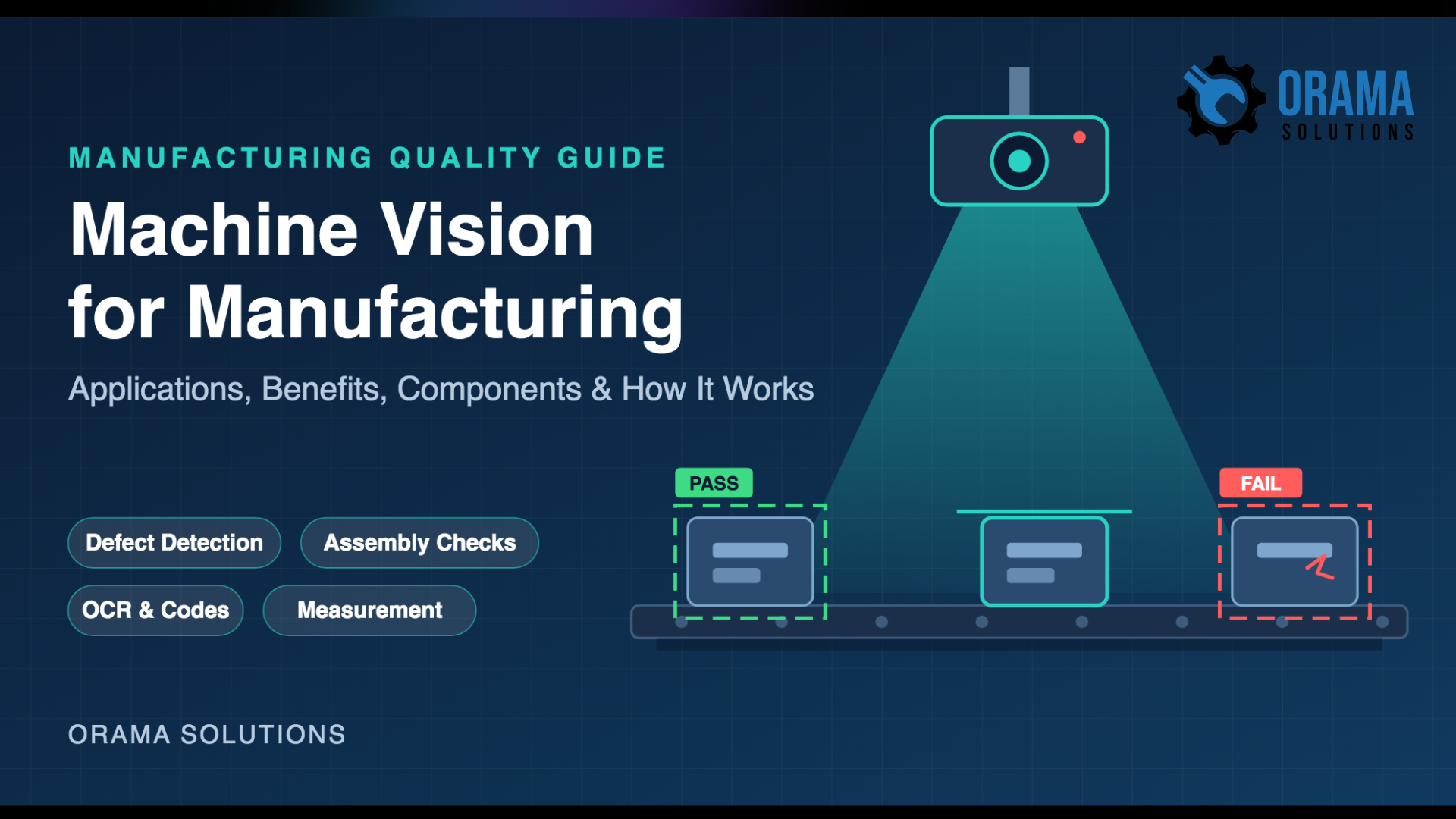
Manufacturing quality depends on the ability to identify defects, verify components, and maintain consistency at every stage of production. Traditionally, these tasks have relied heavily on manual inspection or rule-based automation. However, as production lines become faster and product specifications become more demanding, manufacturers in India and around the world are increasingly turning to machine vision for manufacturing.
Machine vision combines cameras, lighting, image processing, software, and artificial intelligence to enable machines to inspect and analyze products automatically. It can identify missing or incorrect components, detect defects, verify assembly, measure dimensions, read codes, and support quality control in real time. Vision systems for manufacturing are now used across automotive, electronics, pharmaceutical, packaging, and consumer goods plants.
For manufacturers looking to improve inspection accuracy while maintaining production speed, machine vision can provide a scalable approach to automated visual inspection.
Before we proceed, let us understand in detail, what machine vision is.
What Is Machine Vision?
Machine vision is an industrial technology that enables machines to capture, process, and interpret visual information from products, components, or production processes.
A typical machine vision system uses:
Cameras to capture images
Lenses to focus on the inspection area
Lighting to make important features visible
Image processing software to analyze captured images
AI or rule-based algorithms to identify conditions or defects
Industrial computers or processing hardware to run the inspection
PLCs and other automation systems to trigger actions based on inspection results
Unlike human inspectors, a machine vision system can perform repetitive visual inspections continuously and according to predefined inspection criteria.
For example, an inspection system on an assembly line can capture an image of every product passing through a specific inspection station. The system can then determine whether the required components are present, whether they are positioned correctly, and whether visible defects are present.
How Vision Systems for Manufacturing Work
Although machine vision systems can vary significantly depending on the application, the inspection process generally follows a series of steps.
1. Image Capture
A camera captures an image of the product or component being inspected.
The camera, lens, and positioning must be selected according to factors such as product size, inspection speed, required resolution, and the type of defect being inspected. For a closer look at camera types and specifications, read our guide to the machine vision camera.
2. Controlled Illumination
Lighting is critical to machine vision.
Different inspection applications may require different lighting arrangements to highlight edges, surfaces, markings, gaps, or other features.
Poor lighting can make even a sophisticated vision algorithm perform poorly. This is why lighting and camera configuration should be considered as part of the complete inspection system rather than as separate components.
3. Image Processing
The captured image is processed to isolate relevant information.
Depending on the application, the system may identify shapes, edges, patterns, colors, text, components, or other visual characteristics.
4. Inspection and Analysis
The system compares the captured information against predefined criteria.
Traditional machine vision may use rules based on measurements, patterns, thresholds, or geometric characteristics.
AI-powered vision systems can use trained models to recognize more complex patterns and variations.
5. Decision
The system determines whether the product meets the inspection requirements.
For example:
PASS: All required components are present and correctly positioned.
FAIL: A component is missing, incorrectly oriented, damaged, or outside the defined inspection criteria.
6. Automated Action
The inspection result can be communicated to the manufacturing system.
Depending on the application, this may trigger:
Product rejection
Production-line alerts
Operator notifications
Machine stopping
Data logging
Additional inspection
Traceability records
This enables inspection to become part of the production process rather than a separate manual activity.
Key Components of a Machine Vision System
A machine vision solution is more than just an industrial camera. Several components work together to produce reliable inspection results.
Cameras
Cameras capture images of the products or components.
The appropriate camera depends on requirements such as resolution, field of view, inspection speed, image quality, and the characteristics of the product.
Lenses
Lenses determine how the inspection area is captured.
The wrong lens can result in distortion, inadequate coverage, or insufficient detail, affecting inspection accuracy.
Lighting
Lighting determines how clearly the inspection features appear in the image.
Different surfaces and defects may require different lighting configurations, making illumination one of the most important aspects of machine vision system design.
Processing Hardware
Captured images need to be processed quickly enough to keep up with the production line.
Processing may be performed using industrial computers, dedicated vision hardware, or other suitable computing platforms.
Vision Software
Vision software processes images and applies inspection logic.
Depending on the application, this can include measurement, pattern matching, optical character recognition, barcode reading, classification, anomaly detection, or other inspection techniques.
AI Models
AI can add more advanced visual recognition capabilities to machine vision systems.
AI-powered inspection can be particularly useful where products have natural variations or where defects are difficult to define using simple rules.
Industrial Integration
Machine vision systems often need to communicate with existing manufacturing equipment.
Integration may involve PLCs, robots, production-line controls, databases, MES systems, or other factory systems.
Machine Vision Inspection vs Manual Inspection
Manual inspection remains common across many manufacturing environments. Operators visually inspect products and make decisions based on predefined quality standards.
However, manual inspection can become challenging when:
Production volumes are high
Inspection must happen continuously
Defects are small or difficult to see
Products move quickly through the line
Inspection criteria are complex
Repetitive tasks cause operator fatigue
Consistency between inspectors is difficult to maintain
Machine vision inspection can automate repetitive visual checks and provide consistent inspection criteria across production.
This does not necessarily mean replacing every human inspection activity. In many manufacturing environments, machine vision works alongside operators by automating repetitive checks while allowing people to focus on decisions that require human judgment.
Traditional vs AI-Powered Machine Vision
Traditional machine vision generally relies on predefined rules and image-processing techniques.
For example, a system may check whether a component is within a particular position range or whether an object matches a specific geometric pattern.
AI machine vision can approach inspection differently. Machine learning models can be trained to recognize patterns associated with acceptable and defective products.
This can be useful for applications where defects vary in appearance or where traditional rules are difficult to define.
However, AI does not automatically make every vision application better. The appropriate technology depends on the inspection problem, available data, production environment, defect characteristics, and required accuracy. Read more in our guide to AI vision inspection.
Computer Vision vs Machine Vision: What's the Difference?
Computer vision and machine vision are closely related, but they are not exactly the same. Computer vision is the broader field of enabling computers to interpret and understand visual information from images or video. It is used across applications such as autonomous vehicles, security, medical imaging, retail, and robotics.
Machine vision is generally the industrial application of vision technology for automated tasks such as inspection, measurement, identification, guidance, and quality control.
In manufacturing, a machine vision system typically combines cameras, lighting, image processing, software, and automation hardware to inspect products or guide machines. Computer vision techniques, including AI and machine learning, can be incorporated into these systems to handle more complex visual inspection tasks.
In simple terms:
Computer vision = the broader technology of interpreting visual information
Machine vision = applying vision technology to industrial automation and manufacturing
The two terms can overlap, particularly as AI-powered vision systems become more advanced. For manufacturers, the important consideration is not simply which technology is being used, but whether the system can reliably solve the specific inspection or automation challenge.
Where Machine Vision Is Used in Manufacturing
Machine vision can support a wide range of manufacturing processes. Here is a quick overview. For detailed use cases, read our full guide to machine vision applications in manufacturing.
Defect Detection
Vision systems can identify visible defects such as scratches, cracks, contamination, incorrect assembly, surface abnormalities, and other quality issues.
Assembly Verification
Machine vision can verify whether required components are present and whether they are assembled correctly.
For example, an inspection system can check:
Missing components
Incorrect components
Incorrect orientation
Incorrect positioning
Assembly inconsistencies
Measurement and Dimensional Inspection
Machine vision can measure dimensions and verify whether components meet specified tolerances.
This can reduce dependence on manual measurement for repetitive inspection tasks.
OCR and Barcode Reading
Vision systems can read printed characters, labels, barcodes, and other identifiers.
This can support traceability, product identification, and verification.
Click here to know more about AI-Powered OCR and Barcode Reading for Manufacturing
Presence and Absence Detection
A system can determine whether a specific component, feature, label, or part is present.
Surface Inspection
Machine vision can inspect product surfaces for visible imperfections and irregularities.
Packaging Inspection
Vision systems can verify packaging characteristics such as label presence, print quality, positioning, and package integrity.
Machine Vision Defect Detection
Defect detection is one of the most important uses of machine vision in manufacturing.
A production line can generate thousands or millions of products, making it difficult to rely entirely on manual inspection.
An automated vision system can inspect products consistently as they move through the production process.
Depending on the application, inspection may focus on:
Missing parts
Incorrect parts
Surface defects
Assembly errors
Positioning errors
Label defects
Dimensional variations
Printing errors
Foreign objects
Structural abnormalities
AI-based anomaly detection can also be used where defective products do not always follow one clearly defined visual pattern.
Machine Vision in Indian Manufacturing
Indian manufacturers are under growing pressure to meet global quality standards while keeping costs and lead times under control. Machine vision helps address this across several sectors:
Automotive and auto components:
inspecting machined parts, verifying assemblies, and checking dimensions and surface finish for domestic and export customers.
Electronics and EMS:
verifying component placement, reading markings, and catching defects on small, densely populated assemblies.
Pharmaceuticals:
checking labels, packaging, and printed batch information to support compliance and traceability.
FMCG and packaging:
verifying label presence, print quality, seals, and pack completeness at high line speeds.
For plants with high volumes, tight tolerances, and customers who audit quality closely, automated visual inspection can make quality checks more consistent and easier to document.
Benefits of Machine Vision in Manufacturing
Improved Inspection Consistency
Automated systems can apply the same inspection criteria repeatedly, helping reduce variability associated with manual inspection.
Faster Inspection
Machine vision can inspect products at production-line speeds, making it suitable for high-volume manufacturing.
Early Defect Detection
Detecting defects earlier can help manufacturers prevent defective products from progressing further through the production process.
Reduced Rework and Scrap
Identifying problems earlier can reduce the cost associated with rework, scrap, and downstream quality failures.
Better Traceability
Inspection results can be recorded and associated with products, batches, or production events depending on the system architecture.
Improved Quality Control
Continuous automated visual inspection can provide manufacturers with greater visibility into production quality.
Reduced Dependence on Repetitive Manual Inspection
Machine vision can automate repetitive visual checks, allowing human operators to focus on more complex activities.
What is the ROI of Machine Vision?
The return on investment from machine vision depends on the application and production environment.
Manufacturers should look beyond the initial equipment cost and evaluate the overall impact on production and quality.
Potential areas of savings include:
Reduced inspection labour
Lower scrap rates
Reduced rework
Fewer escaped defects
Improved production throughput
Reduced customer returns
Lower quality-related costs
Improved production consistency
A proper ROI assessment should compare the cost of implementing the vision system with measurable improvements in inspection and production performance.
How to Choose a Machine Vision System
There is no single machine vision configuration that works for every manufacturing application.
Manufacturers should consider:
Inspection Objective
Clearly define what the system needs to detect, measure, read, or verify.
Product Characteristics
Consider product size, shape, material, color, surface finish, and natural variation.
Defect Characteristics
Understand the size, appearance, location, and variability of the defects.
Production Speed
The system must capture and process images quickly enough to keep pace with production.
Accuracy Requirements
Determine the required detection accuracy and acceptable false-positive and false-negative rates.
Environmental Conditions
Temperature, vibration, dust, reflections, ambient lighting, and other factory conditions can affect system performance.
Integration Requirements
Consider how the vision system will communicate with PLCs, robots, production systems, databases, and other factory infrastructure.
Scalability
A system should ideally support future inspection requirements and production changes where possible.
For a step-by-step selection framework, read our full guide to choosing a machine vision system.
The Future of Machine Vision in Manufacturing
Machine vision is increasingly moving beyond basic image-based inspection toward more intelligent and connected quality-control systems.
AI is enabling vision systems to handle more complex visual patterns, while improvements in computing and industrial connectivity are making real-time inspection increasingly practical.
Future manufacturing vision systems are likely to become more closely integrated with broader production and quality systems, allowing inspection data to contribute to continuous process improvement.
The objective is not simply to identify defective products. It is to use inspection data to understand why defects occur, where they occur, and how manufacturing processes can be improved.
Machine vision has become an important technology for manufacturers seeking to automate inspection, improve consistency, and maintain quality at production speed.
From defect detection and assembly verification to measurement, OCR, barcode reading, and surface inspection, machine vision can address a wide range of manufacturing requirements. Automated visual inspection, in particular, gives manufacturers a consistent way to check every product without slowing the line.
The most effective system depends on the specific production challenge. Camera selection, lighting, software, AI models, processing capabilities, and factory integration all play important roles in determining inspection performance.
For manufacturers considering automation, the starting point should not be the question, "Which camera should we buy?" Instead, it should be:
"What quality or inspection problem are we trying to solve?"
Once the inspection objective is clearly defined, the appropriate machine vision architecture, technology, and implementation approach can be determined.
For manufacturers exploring AI-powered inspection, Orama Solutions helps apply computer vision and AI to real-world manufacturing challenges such as assembly verification, defect detection, OCR and barcode inspection, and automated visual quality control.
Already have a machine vision system on the line? We can audit it for free.
Call +91 9999282700